
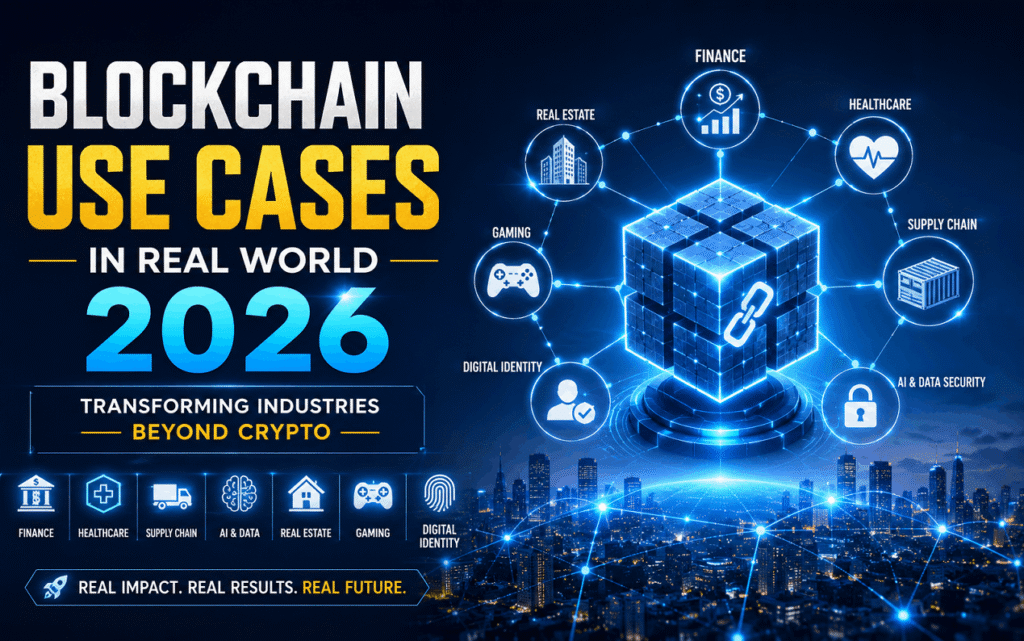
Just a few years ago, blockchain was mostly associated with cryptocurrency. For many people, the word blockchain simply meant Bitcoin, trading, wallets and digital coins. But in 2026, that understanding is incomplete. Blockchain has moved far beyond the crypto market and is now becoming a serious digital infrastructure for businesses, governments, creators, financial institutions, healthcare systems and even everyday consumers.
The most powerful thing about blockchain is not hype. It is trust. In a digital world where data can be copied, edited, manipulated or deleted, blockchain creates a shared record that is transparent, secure, traceable and difficult to tamper with. That is why industries are using blockchain for supply chain tracking, digital identity, smart contracts, real estate ownership, healthcare records, financial settlements, AI data verification and more.
This guide explains the most important blockchain use cases in real world 2026 in a simple, practical and business-focused way.
Table of Contents
- What Is Blockchain Technology?
- Why Blockchain Adoption Is Growing in 2026
- Blockchain in Finance
- Blockchain in Healthcare
- Blockchain in Supply Chain Management
- Blockchain in AI and Data Security
- Blockchain in Real Estate
- Blockchain for Digital Identity
- Blockchain in Gaming and Digital Ownership
- How Businesses Can Use Blockchain
- Best Blockchain Platforms and Ecosystems
- Smart Content and Revenue Opportunities
- FAQs
- Final SEO Output
What Is Blockchain Technology?
Quick Answer
Blockchain is a decentralized digital ledger that records data or transactions across multiple computers. Once information is added, it becomes difficult to change, making blockchain useful for security, transparency, verification and automation.
To understand blockchain simply, imagine a digital notebook that is shared with many trusted participants at the same time. Whenever a new transaction or record is added, everyone in the network can verify it. Once verified, the record becomes part of a chain of blocks. This makes the system more transparent and less dependent on a single authority.
Traditional databases are usually controlled by one company, bank, government department or platform. Blockchain works differently. It distributes records across a network. This is why it is often called distributed ledger technology.
Core Features of Blockchain
- Transparency: Records can be verified by authorized participants.
- Security: Data is protected using cryptographic methods.
- Immutability: Once confirmed, records are extremely difficult to alter.
- Traceability: Transactions can be tracked from origin to destination.
- Automation: Smart contracts can execute actions automatically.
This is why blockchain is now being used for much more than digital currencies. It is becoming a trust layer for digital business.
Why Blockchain Adoption Is Growing Fast in 2026
Blockchain adoption in 2026 is not growing because of hype alone. It is growing because businesses now need stronger systems for trust, automation, compliance and digital verification. As artificial intelligence, digital payments, global e-commerce and online identity systems expand, the need for reliable data infrastructure becomes more important.
1. Businesses Need Better Transparency
Customers now want to know where products come from, whether brands are ethical, whether goods are original and whether claims are genuine. Blockchain helps companies prove product origin, transaction history and ownership records.
2. AI Needs Verified Data
Artificial intelligence depends on data. But if the data is fake, biased, stolen or manipulated, AI results become unreliable. Blockchain can help verify datasets, track data usage and prove ownership of digital content.
3. Financial Systems Want Faster Settlements
Traditional finance often involves multiple intermediaries. Blockchain can reduce settlement time, improve auditability and make certain transactions more efficient.
4. Real-World Asset Tokenization Is Expanding
Real estate, bonds, commodities, invoices, securities and other assets can be represented digitally on blockchain networks. This is called tokenization. It can improve liquidity, fractional ownership and transaction efficiency.
5. Enterprises Prefer Hybrid and Permissioned Blockchain
Large companies do not always want fully public blockchain systems. In 2026, many enterprises prefer private, permissioned or hybrid blockchain models where access, compliance and performance can be controlled.
Top Real-World Blockchain Use Cases in 2026
The real value of blockchain becomes clear when we look at practical use cases. In 2026, blockchain is being used across industries where trust, verification, ownership, payments and transparency matter.
| Industry | Blockchain Use Case | Business Benefit |
|---|---|---|
| Finance | Payments, settlements, tokenized assets | Faster transactions and better transparency |
| Healthcare | Medical records and drug traceability | Improved patient data security |
| Supply Chain | Product tracking and authenticity | Reduced fraud and stronger trust |
| AI | Data verification and content proof | Better trust in AI-generated systems |
| Real Estate | Property records and tokenized ownership | Faster transactions and fractional access |
| Gaming | Digital assets and ownership | True ownership of in-game items |
| Government | Identity, land records, public data | Reduced paperwork and corruption risk |
Blockchain in Finance: Faster, Smarter and More Transparent Transactions
Finance is one of the strongest real-world applications of blockchain technology. Banks, payment companies, fintech startups and asset managers are exploring blockchain to reduce friction in transactions and improve trust in financial records.
Cross-Border Payments
International money transfers can be slow and expensive because they often pass through multiple banks and intermediaries. Blockchain-based payment rails can make cross-border payments faster, more transparent and easier to track.
Smart Contracts in Financial Services
Smart contracts are self-executing digital agreements. In finance, they can automate processes such as loan approvals, escrow releases, trade settlements and insurance claim triggers.
Tokenized Securities and Assets
One of the biggest trends in 2026 is the tokenization of traditional assets. Stocks, bonds, funds, invoices and real estate can be represented as digital tokens. This does not mean traditional finance disappears. Instead, blockchain can upgrade the infrastructure behind financial transactions.
Important Insight: The future of blockchain in finance is not only about cryptocurrency trading. The bigger opportunity is in settlement systems, tokenized assets, compliance records and programmable financial infrastructure.
Real-Life Example
Large financial institutions are already experimenting with blockchain-based settlement, digital asset custody and tokenized financial instruments. This shows that blockchain is gradually moving from experimental innovation to serious financial infrastructure.
Blockchain in Healthcare: Secure Medical Records and Drug Traceability
Healthcare is one of the most sensitive sectors because patient data must be protected carefully. Hospitals, insurance companies, pharmacies, laboratories and health-tech platforms handle large amounts of private information. Blockchain can help create secure, traceable and permission-based data systems.
Patient Data Security
Medical records are often stored across different hospitals, clinics and diagnostic centers. This creates problems such as duplicate records, missing history and security risks. Blockchain can help create a verified patient record system where authorized users can access accurate information securely.
Drug Supply Chain Tracking
Counterfeit medicines are a serious global concern. Blockchain can track medicines from manufacturer to distributor, pharmacy, hospital and patient. This improves trust and helps reduce fake or unsafe medicines.
Insurance Claim Automation
Health insurance claims usually involve paperwork, verification and delays. Smart contracts can automate parts of claim processing when predefined conditions are met. This can reduce fraud and improve claim speed.
Medical Research and Data Sharing
Researchers need reliable health data, but privacy must be protected. Blockchain can support secure, consent-based sharing of medical datasets while maintaining a clear record of who accessed the data and when.
Blockchain in Supply Chain Management: From Factory to Customer
Quick Answer
Blockchain improves supply chain transparency by allowing businesses and consumers to track products from origin to final delivery. It helps verify authenticity, reduce fraud and improve accountability.
Supply chains are complex. A single product may pass through raw material suppliers, manufacturers, warehouses, logistics providers, distributors, retailers and customers. If something goes wrong, it can be difficult to identify where the problem happened.
Blockchain solves this by creating a shared record of product movement. Every step can be recorded and verified.
Food Industry
Food companies can use blockchain to track where ingredients came from, when they were processed, how they were transported and whether storage conditions were maintained.
Luxury Goods
Fake luxury products are a major problem. Blockchain can verify authenticity by linking each product to a digital certificate.
Automotive Industry
Car manufacturers can track spare parts, supplier quality, warranty records and maintenance history using blockchain-based systems.
E-Commerce
Online marketplaces can use blockchain to reduce counterfeit goods and prove seller authenticity.
Customer Example
Imagine buying organic coffee. By scanning a QR code, you can see the farm location, harvest date, quality checks, shipping details and sustainability certifications. This creates trust and improves brand loyalty.
Blockchain in AI and Data Security: The Trust Layer for Artificial Intelligence
Artificial intelligence is becoming deeply integrated into content creation, business automation, customer support, healthcare, finance and education. But AI creates a new problem: how do we know what is real original, verified or trustworthy?
This is where blockchain can play an important role.
AI Content Verification
As AI-generated images, videos, voices and articles become more realistic, blockchain can help prove the origin and ownership of digital content. This is useful for media companies, creators, brands and legal systems.
Trusted AI Datasets
AI models need training data. Blockchain can record where datasets came from, whether consent was given and how the data was used.
Decentralized AI Marketplaces
Developers may use blockchain-based systems to sell AI models, datasets or automation tools with transparent ownership and payment records.
Data Ownership for Users
In the future, users may have more control over their personal data. Blockchain can help individuals decide who can access their data and under what conditions.
Future-Focused Insight: AI will create speed. Blockchain will create verification. Together, they can support a more trusted digital economy.
Blockchain in Real Estate: Property Records, Smart Contracts and Tokenized Ownership
Real estate is traditionally slow, paperwork-heavy and dependent on multiple intermediaries. Buying or selling property may involve agents, banks, lawyers, government records, registration departments and manual verification.
Blockchain can simplify several parts of this process.
Property Ownership Records
Land and property records can be stored on blockchain to reduce disputes, fraud and unauthorized changes.
Smart Contract-Based Transactions
Smart contracts can automate certain parts of property transactions, such as escrow release, payment confirmation and ownership transfer.
Tokenized Real Estate
Instead of buying an entire property, investors can buy fractional ownership through digital tokens. This can make real estate investment more accessible to smaller investors.
Rental Agreements
Rental payments, security deposits and agreement terms can be managed using smart contracts, reducing disputes between landlords and tenants.
Blockchain for Digital Identity: Safer Online Verification
Digital identity is becoming one of the most important blockchain use cases in real world 2026. From banking to travel, education, healthcare and government services, identity verification is required everywhere.
Problems With Traditional Identity Systems
- Data is stored in centralized databases
- Users repeatedly submit the same documents
- Identity theft risk is increasing
- KYC verification can be slow
- Fake documents are difficult to detect
How Blockchain Helps
Blockchain-based identity systems can give users more control over their personal information. Instead of sharing full documents everywhere, users may share verified proofs.
Practical Use Cases
- Bank account verification
- Online education certificates
- Healthcare identity records
- Travel documentation
- Government benefit verification
Blockchain in Gaming and Digital Ownership
Gaming is no longer just entertainment. It has become a digital economy. Players buy skins, characters, weapons, passes, collectibles and virtual land. But in traditional games, these assets usually remain controlled by the gaming company.
Blockchain changes this by enabling true digital ownership.
NFT-Based Game Assets
Players can own unique digital items that may be transferred, sold or used across compatible ecosystems.
Creator-Owned Economies
Game developers, artists and creators can build digital assets and earn from their usage or resale.
Interoperability
In the future, some gaming assets may move between platforms, creating more flexible digital economies.
Important Reality Check
Not every blockchain game succeeds. The best projects are those that focus first on gameplay, user experience, community and long-term utility instead of only digital asset speculation.
Blockchain in Government and Public Services
Governments can use blockchain for transparent, tamper-resistant public records. While full implementation takes time, the potential is strong.
Land Records
Blockchain can reduce land ownership disputes by creating reliable digital records.
Public Welfare Distribution
Benefits and subsidies can be tracked transparently to reduce leakage and fraud.
Voting Systems
Blockchain-based voting is still a sensitive and complex area, but research continues because transparent verification could improve trust if implemented carefully.
Education Certificates
Universities and institutions can issue blockchain-verified certificates to reduce fake degrees and simplify employer verification.
Step-by-Step: How Businesses Can Start Using Blockchain
Step-by-Step Answer
- Identify where trust, verification or transparency is needed.
- Choose whether blockchain is truly required.
- Select a suitable blockchain platform.
- Start with a small pilot project.
- Integrate blockchain with existing business systems.
- Measure cost savings, trust improvement and operational efficiency.
Step 1: Identify the Real Problem
Do not use blockchain just because it sounds advanced. Use it where there is a genuine need for shared trust, verification, auditability or automation.
Step 2: Decide the Type of Blockchain
- Public blockchain: Open and decentralized networks.
- Private blockchain: Controlled by one organization.
- Permissioned blockchain: Limited access for selected participants.
- Hybrid blockchain: Combines public transparency with private controls.
Step 3: Build a Pilot
Start with one use case such as product tracking, certificate verification, payment automation or customer loyalty records.
Step 4: Check Legal and Compliance Requirements
Finance, healthcare, identity and real estate use cases must follow relevant laws and data protection rules.
Step 5: Improve User Experience
The best blockchain products do not force users to understand technical terms. They simply deliver better trust, speed and security in the background.
Best Blockchain Platforms and Ecosystems for Businesses in 2026
| Platform | Best For | Why It Matters |
|---|---|---|
| Ethereum | Smart contracts and decentralized apps | Large ecosystem and strong developer community |
| Polygon | Scalable Web3 applications | Lower transaction costs and faster performance |
| Hyperledger | Enterprise blockchain | Suitable for permissioned business networks |
| Solana | High-speed applications | Useful for fast transactions and financial applications |
| Avalanche | Financial ecosystems and custom networks | Flexible infrastructure for blockchain applications |
The right platform depends on your use case. A healthcare company, gaming startup, financial institution and supply chain business may all need different blockchain architectures.
Smart Content and Revenue Opportunities Around Blockchain Topics
If you run a technology, finance, crypto or Web3 content website, blockchain topics can create strong educational and commercial value. The key is to recommend helpful resources naturally instead of sounding promotional.
Recommended Partner Placement Ideas
- Crypto education platforms: Place naturally inside beginner learning sections.
- Secure wallet solutions: Mention inside blockchain security and digital ownership topics.
- Blockchain courses: Add after career-focused sections.
- Web3 platforms: Include in comparison-style guides.
- Cloud mining or passive crypto platforms: Mention only where the topic naturally discusses blockchain-powered earning models.
Want to Explore Blockchain Opportunities?
Start with education first. Understand wallets, smart contracts, security, blockchain platforms and real-world use cases before choosing any platform or service.
Explore Beginner-Friendly BlockchainBest Placement Strategy
The most effective placement is not a hard promotion. Instead, use contextual CTAs like:
- “Compare beginner-friendly blockchain platforms”
- “Explore secure ways to store digital assets”
- “Learn how blockchain-powered earning models work”
- “Check trusted tools for Web3 beginners”
This approach feels natural, improves user trust and increases conversion potential without damaging content quality.
Future Blockchain Trends to Watch in 2026 and Beyond
1. Real-World Asset Tokenization
Tokenization will continue expanding into real estate, securities, commodities, invoices and financial products.
2. Blockchain and AI Integration
Blockchain may become the verification layer for AI-generated content, datasets and automated decisions.
3. Green Blockchain Networks
Energy-efficient blockchain systems will gain more attention as sustainability becomes important.
4. Enterprise Web3 Infrastructure
Businesses will increasingly use blockchain in the background for compliance, traceability and digital workflows.
5. Decentralized Identity
Users may gain more control over their personal information through self-sovereign identity systems.
Trusted Authority References to Mention
For stronger E-E-A-T, you can mention insights from trusted organizations such as:
- World Economic Forum
- Deloitte
- Gartner
- IBM Research
- McKinsey Digital
- Reuters financial technology coverage
- Academic healthcare and blockchain research publications
FAQs About Blockchain Use Cases in Real World 2026
What are the main blockchain use cases in 2026?
The main blockchain use cases in 2026 include finance, healthcare, supply chain tracking, AI data verification, digital identity, real estate tokenization, gaming assets and government records.
Is blockchain only used for cryptocurrency?
No. Cryptocurrency is only one use case. Blockchain is also used for business records, smart contracts, product tracking, identity verification, healthcare data and financial settlements.
How is blockchain used in real life?
Blockchain is used in real life to track products, secure patient records, verify digital identity, automate contracts, process payments, prove ownership and reduce fraud.
Which industries benefit most from blockchain?
Finance, healthcare, logistics, real estate, gaming, government services and AI-driven businesses benefit most from blockchain because they require trust, traceability and secure records.
Can small businesses use blockchain?
Yes. Small businesses can use blockchain for product authenticity, loyalty programs, digital certificates, payment systems, transparent supply chains and secure customer records.
What is the future of blockchain technology?
The future of blockchain technology is likely to focus on AI verification, real-world asset tokenization, digital identity, enterprise automation and secure data infrastructure.
Is blockchain a good career opportunity in 2026?
Yes. Blockchain offers career opportunities in development, cybersecurity, smart contract auditing, Web3 strategy, enterprise architecture, compliance and digital asset management.
Final Thoughts
Blockchain in 2026 is no longer just a buzzword. It is becoming a practical technology for solving real business problems. Its biggest strength is not speculation. Its biggest strength is creating trust in a digital world.
From finance and healthcare to supply chains, AI, real estate, gaming and identity verification, blockchain is quietly becoming part of modern digital infrastructure. Many users may not even realize they are using blockchain-powered systems because the best technology often works silently in the background.
For businesses, the opportunity is clear: use blockchain where trust, transparency, ownership, verification or automation creates measurable value. For content creators and bloggers, the opportunity is equally strong: explain blockchain in simple language, target real-world problems and guide readers toward useful resources naturally.
The next phase of blockchain growth will not be about hype. It will be about utility, trust, compliance and real-world adoption.
Must Read Topics
- Best Crypto platform to Earn Passive Income in 2026
- Top Blockchain Trends 2026: Future of Web3 & Digital Finance
- AI and Blockchain Future Explained
- How Smart Contracts Work for Beginners
- Best Crypto Wallets for Beginners
- Web3 vs Traditional Internet
- How Tokenization Works in Real Estate
- Blockchain Security Tips for Beginners